Bitget wallet: Features, security, and how it works
Bitget wallet Is a Web3 wallet for managing crypto across chains
Bitget wallet Is a self-custody Web3 wallet used to store, send, receive, swap, and interact with digital assets across multiple blockchain networks. It is designed for users who want one app for crypto balances, decentralized applications, tokens, NFTs, stablecoins, and Web3 payments. Like any crypto wallet, Bitget wallet requires careful setup, strong security habits, and verification through official sources before users trust it with meaningful funds.
What is Bitget wallet?
Bitget wallet is a crypto wallet application built for Web3 activity rather than only basic coin storage. In practical terms, it gives a user a place to manage assets, connect to decentralized applications, explore markets, trade tokens, and use blockchain-based services from a mobile or browser-based environment. Bitget wallet may be used by people who already understand exchanges and DeFi, but it is also often discovered by beginners looking for a simple starting point.
Bitget wallet sits in the broader category of non-custodial or self-custody wallets, depending on the account mode a user chooses. That distinction matters. With a self-custody wallet, the user is responsible for the wallet credentials that control access to assets on-chain. Bitget wallet can provide the interface, but the blockchain records and private key model determine who can move funds. This is powerful, but it also means mistakes can be expensive and sometimes irreversible.
Bitget wallet is not the same thing as a bank account, a brokerage account, or a guaranteed savings product. It is better understood as software for accessing blockchain networks. A user might hold stablecoins such as USDT or USDC, interact with DeFi protocols, explore NFTs, or move funds between addresses. The experience can feel app-like, but the underlying transactions still rely on blockchains, network fees, smart contracts, and the security of the user's own device and credentials.
How does Bitget wallet work?
Bitget wallet works by creating or importing a wallet account that can sign blockchain transactions. When a user sends crypto, swaps tokens, approves a smart contract, or connects to a decentralized app, the wallet prepares a transaction and asks the user to confirm it. After confirmation, the transaction is broadcast to the relevant blockchain network, where validators or miners process it according to that network's rules.
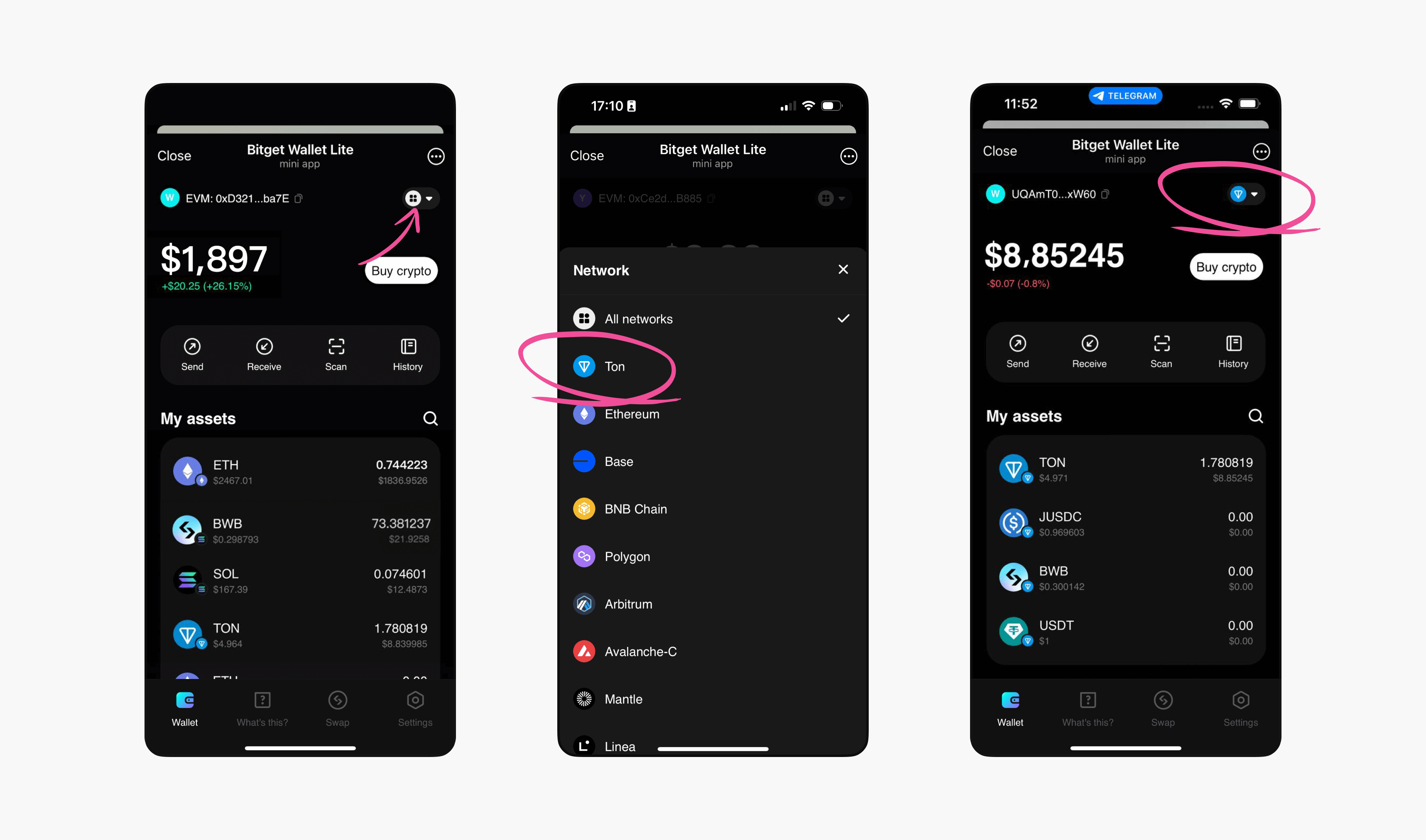
Bitget wallet can support activity across multiple chains, which is one reason users search for it. A multi-chain wallet reduces the need to install a separate app for every network. For example, a user may want to view assets on Ethereum, BNB Chain, Solana, Tron, Base, or other supported ecosystems. The exact supported networks and tokens can change, so users should confirm current availability inside the official Bitget wallet app or official website before planning a transfer.
The wallet interface usually simplifies technical details, but the details still matter. Every network has its own address formats, token standards, transaction fees, and confirmation behavior. Bitget wallet may show a single balance screen, yet a USDT balance on Tron is not identical to USDT on Ethereum or Base. Sending assets on the wrong network can create recovery problems. Before using Bitget wallet for larger transfers, users should understand the chain, token contract, recipient address, and fee token required for the transaction.
What can you use Bitget wallet for?
Bitget wallet can serve several common crypto workflows. Many users start with simple storage and transfers, then explore swaps, staking interfaces, decentralized finance, NFT viewing, or Web3 discovery. The appeal is convenience: Bitget wallet can place wallet balances, market tools, trading access, and dApp browsing in one environment. That does not remove risk, but it can make routine Web3 navigation easier for people who use crypto frequently.
Bitget wallet is also relevant to stablecoin users. Stablecoins such as USDT and USDC are widely used for transfers, remittances, savings-like holding behavior, and trading liquidity, especially in markets where people want dollar-denominated digital value. Some wallet features may let users convert stablecoins or connect them to payment flows through partners. Availability, limits, fees, bank support, and settlement rules vary by country and should be checked directly in the product before relying on them.
Common uses for Bitget wallet include:
Receiving and holding supported cryptocurrencies and stablecoins.
Sending assets to another wallet address or compatible service.
Swapping tokens through available routing or exchange features.
Connecting to decentralized applications and DeFi tools.
Viewing NFTs or other blockchain-based assets where supported.
Using payment-related features when they are available in the user's region.
Bitget wallet can be useful for active Web3 users, but each use case has a different risk profile. A simple deposit to a known address is not the same as approving a smart contract or bridging assets across chains. The more complex the action, the more important it becomes to review transaction details slowly.
How to get started with Bitget wallet
Bitget wallet setup generally begins by installing the official app or accessing the official wallet product. Users should avoid random download links, social media files, sponsored impostor pages, and copied app names. Crypto wallet phishing is common, and a fake wallet can steal recovery phrases or redirect deposits. For that reason, the first step is not creating the wallet; it is verifying that the software source is legitimate.
Bitget wallet may offer different ways to create an account, such as a traditional mnemonic recovery phrase wallet or a keyless login-style wallet, depending on the current app version and region. A mnemonic wallet gives the user a recovery phrase that controls the assets. A keyless option can feel more familiar because it may use email, Apple ID, Google login, or similar authentication flows, but users still need to understand how recovery, access, and security are handled.
For a new user, the safest workflow is usually to begin with a small test amount. Create or import the wallet, back up the recovery method, confirm the network, send a tiny transfer, and verify it arrives before moving more value. Bitget wallet may make the process look simple, but blockchain transfers are not always reversible. A test transaction can catch address mistakes, network mismatches, missing gas tokens, or confusion about token versions.
A basic Bitget wallet workflow looks like this:
Download or access Bitget wallet only through an official source.
Create a new wallet or import an existing wallet you already control.
Back up the recovery phrase or recovery method before adding funds.
Set a strong PIN, passcode, biometric lock, or device-level protection.
Test with a small transfer on the correct network.
Review every transaction request before approving it.
Bitget wallet is easier to use when the user keeps records organized. That does not mean storing a seed phrase in a cloud note or screenshot. It means knowing which chain each asset is on, which addresses belong to you, which apps you have approved, and which official sources you use for updates.
Is Bitget wallet safe?
Bitget wallet can include security features, but no wallet is automatically safe in every situation. Wallet security depends on the app, the user's device, the recovery method, the websites the user connects to, and the choices made during transaction approval. A secure wallet can still lose funds if a user signs a malicious approval, shares a recovery phrase, installs a fake app, or sends assets to the wrong address.
Bitget wallet users should treat the recovery phrase as the master key for a traditional self-custody wallet. Anyone who obtains that phrase can potentially control the assets. It should not be typed into random websites, sent to support accounts, stored in screenshots, pasted into chat windows, or saved in unencrypted cloud storage. Legitimate wallet support should not need the recovery phrase to troubleshoot a normal account issue.
In practice, Bitget wallet safety is strongest when paired with conservative habits. Keep the app updated, use the official distribution channel, protect the device with a strong unlock method, avoid public Wi-Fi for sensitive actions, and review permissions after using dApps. If Bitget wallet supports hardware wallet connections or additional authentication features in a given environment, advanced users may consider those options for larger balances.
Smart contract approvals require extra attention
Bitget wallet may ask users to approve token spending when interacting with decentralized exchanges, DeFi pools, NFT marketplaces, or other Web3 applications. These approvals can sometimes grant broad permissions. Before confirming, users should check the app identity, token, amount, chain, and purpose of the request. Revoking old approvals can reduce exposure, although it also requires network fees.
Stablecoins have their own risks
Bitget wallet users who hold USDT, USDC, or other stablecoins should remember that stablecoins are not risk-free cash. They depend on issuers, reserves, redemption rules, blockchain availability, regulatory treatment, and market confidence. A stablecoin may be designed to track a fiat currency, but users should still verify issuer information, supported chains, and redemption limits through official sources.
Fees and costs of Bitget wallet
Bitget wallet costs can include network fees, swap spreads, routing fees, partner fees, payment fees, bridge costs, or withdrawal-related charges, depending on the action. A transfer on one chain may cost very little, while the same type of transfer on another chain may cost more during congestion. Bitget wallet may display estimated fees before confirmation, but the user should review the final transaction screen carefully.
Bitget wallet does not control every fee in the process. Blockchain gas fees are paid to the network, not simply to the wallet interface. Swap pricing can depend on liquidity pools, decentralized exchange routes, slippage settings, and token volatility. Bank transfer or card-related features, where available, may involve licensed partners and local payment rails. The practical cost is the total amount received after fees, exchange rates, spreads, and settlement charges.
Before using Bitget wallet for stablecoin-to-fiat or payment activity, users should verify supported countries, supported banks, limits, estimated arrival time, conversion rate, and compliance requirements. Features can roll out by market and may not be available everywhere. A function that works for one user in one country may be unavailable or different for another user.
How Bitget wallet compares with other crypto wallets
Bitget wallet competes in a crowded category that includes mobile wallets, browser extension wallets, exchange-linked wallets, hardware wallet companion apps, and chain-specific wallets. The right choice depends less on brand recognition and more on user needs. A beginner may value a clean interface and guided setup, while an advanced DeFi user may prioritize chain coverage, transaction simulation, custom RPC controls, approval management, or hardware wallet compatibility.
Bitget wallet may appeal to users who want a broad Web3 app with token management, market access, discovery tools, and payment-related features in one place. A more minimal wallet may be better for someone who only wants to receive and hold a single asset. A hardware wallet may be preferable for long-term storage of significant value, because private keys can remain isolated from everyday phone or browser activity.
Requires careful transaction review and device security
Hardware wallets
Stronger key isolation for long-term storage
Less convenient for frequent mobile activity
Exchange accounts
Simple buying, selling, and account recovery
User does not fully control private keys
Chain-specific wallets
Deep support for one ecosystem
Less convenient across many networks
Bitget wallet should be evaluated as part of a broader security and usability plan. Many experienced users separate funds by purpose: small hot wallet balances for daily activity, separate wallets for DeFi testing, and colder storage for long-term holdings. That kind of separation can limit damage if one app, approval, or address becomes compromised.
Benefits and limitations to understand before using Bitget wallet
Bitget wallet offers convenience, especially for users who move between tokens, chains, and Web3 applications. The ability to manage multiple assets from one interface can reduce friction. Payment features, stablecoin support, QR-based flows, marketplace-style tools, or bank-transfer integrations may make crypto more practical in supported regions. For users who already rely on stablecoins, Bitget wallet can feel like a bridge between on-chain value and everyday financial activity.
The limitations are just as important. Bitget wallet cannot remove blockchain risk, market volatility, phishing risk, smart contract bugs, regulatory uncertainty, or the possibility of user error. A polished app interface can make crypto feel familiar, but it does not change the finality of many transactions. If a user sends funds to the wrong address or signs a harmful contract approval, recovery may be difficult or impossible.
Bitget wallet users should also be careful about promises that sound too certain. High yields, guaranteed returns, urgent airdrops, bonus claims, and support messages asking for wallet credentials are warning signs. Web3 scams often imitate real brands and time-sensitive opportunities. The more valuable the transaction, the more slowly it should be reviewed.
Who is Bitget wallet best suited for?
Bitget wallet is best suited for users who want an active Web3 wallet and are willing to learn the responsibilities that come with self-custody. It can fit people who use stablecoins, explore DeFi, move assets across supported chains, or want an app-centered way to interact with crypto services. It is less suitable for someone who wants guaranteed protection from mistakes, traditional bank-style chargebacks, or a completely hands-off savings product.
For a beginner, Bitget wallet can be approachable if used carefully and gradually. Start with education, small amounts, and official help resources. For an advanced user, Bitget wallet may be one part of a larger setup that includes hardware storage, multiple addresses, approval monitoring, tax records, and security routines. In both cases, the user should verify current features, fees, supported networks, and regional availability with official Bitget wallet sources.
Bitget wallet is ultimately a tool. It can make digital asset management more accessible, but it does not make crypto simple in the same way a conventional app does. The best results come from treating every transfer, swap, approval, and payment as a real financial action that deserves review. Used with caution, Bitget wallet can help users navigate Web3 more efficiently while keeping the central responsibility clear: control of the wallet also means responsibility for protecting it.
Reader rating:
4.4 / 5
based on 508 ratings
Questions and Answers
What is Bitget wallet used for?
Bitget wallet is used to manage crypto assets, send and receive tokens, access supported blockchain networks, explore Web3 applications, and interact with DeFi or NFT services where available. Some users also use it for stablecoins such as USDT and USDC. Availability of chains, tokens, swaps, and payment features can change, so users should verify current details through official Bitget wallet sources before relying on a specific function.
Is Bitget wallet a self-custody wallet?
Bitget wallet can be used as a self-custody wallet when a user creates or imports a wallet controlled by recovery credentials such as a seed phrase. In that setup, the user is responsible for protecting access to the wallet. Some versions or account modes may offer keyless or login-based options, so users should review how recovery, control, and account access work before depositing funds.
How do I start using Bitget wallet safely?
Start by downloading Bitget wallet only from an official source, then create or import a wallet and back up the recovery method before adding funds. Use a strong device lock, avoid screenshots of recovery phrases, and send a small test transaction first. Review the chain, address, token, fees, and transaction details before every approval, especially when connecting to decentralized applications.
Does Bitget wallet support USDT and USDC?
Bitget wallet is commonly associated with stablecoin activity, including assets such as USDT and USDC on supported networks. However, stablecoin availability depends on the app version, region, network, and current product support. Users should confirm the exact chain and token contract before sending funds, because USDT or USDC on one blockchain is not the same as the token on another blockchain.
Can Bitget wallet transfer crypto to a bank account?
Bitget wallet may offer bank-transfer or stablecoin-to-fiat features in selected markets through payment partners, but these services are not universal. Supported countries, banks, currencies, fees, limits, and processing times can vary. Before using this type of feature, check the official app for current availability and review the conversion rate, compliance requirements, and final amount expected to arrive.
What are the main risks of using Bitget wallet?
The main risks include losing a recovery phrase, installing a fake app, sending assets on the wrong network, approving a malicious smart contract, falling for phishing, or misunderstanding token and stablecoin risks. Bitget wallet can provide an interface and security features, but users still need careful habits. Crypto transactions are often irreversible, so small tests and slow review are important.
How does Bitget wallet compare with an exchange account?
Bitget wallet is generally used for Web3 access and wallet-based control of assets, while an exchange account is typically used for buying, selling, and account-based custody. With a self-custody wallet, the user may control the keys and can connect to decentralized applications. With an exchange account, recovery may be easier, but the user may not directly control private keys.
Bitget Wallet
has launched a new Bank Transfer feature in Nigeria and Mexico, enabling users to convert USDT and USDC directly into local currencies and send funds to domestic bank accounts. The rollout represents one of the first large-scale attempts by a global crypto wallet to integrate stablecoin payments with traditional banking infrastructure in both markets.
The feature allows users to make payments or transfers by selecting a stablecoin, specifying an amount, and entering a bank account number, with fiat conversion handled behind the scenes by Bitget Wallet’s network of licensed partners. These partners manage settlement through regulated payment channels, providing instant processing to more than 45 banks in Nigeria and over 35 in Mexico. The service supports USDT and USDC across multiple chains, including Ethereum, BNB Chain, Solana, Tron, and Base.
The development comes as stablecoins continue to gain traction in emerging markets, where they are increasingly used for savings, payments, and remittances amid inflation and currency instability. According to Chainalysis, Nigeria recorded over $90 billion in annual on-chain transaction value, while Mexico logged more than $70 billion, together representing roughly $160 billion in crypto activity.
By enabling direct stablecoin-to-fiat transfers, Bitget Wallet aims to reduce friction in converting crypto into usable local money. In Nigeria, many users rely on peer-to-peer platforms that can be affected by liquidity shortages and volatile exchange rates. In Mexico, access to crypto-to-fiat services remains limited by infrastructure gaps and regulatory constraints. The new feature seeks to address these barriers by offering instant, compliant settlement within minutes.
“Stablecoins are quickly becoming a new layer of everyday payments in emerging markets, and connecting them to local banking rails is the next step in that evolution,” said
Jamie Elkaleh, CMO of Bitget Wallet.
“Nigeria and Mexico together process more than $160 billion in annual on-chain volume. Bringing instant stablecoin payments directly into their banking systems makes self-custody more practical, more usable, and increasingly aligned with how people pay today.”
Bitget Wallet plans to extend the Bank Transfer service to additional emerging markets in the coming months, building on its suite of payment tools that includes a crypto card, QR-based payments, and an in-app lifestyle marketplace.
Previous Article
November 28, 2025
Revolut taps Nasdaq to power next phase of global compliance